Studio
Ubisoft is one of the largest video game studios in the world, and the largest in France, with thousands of employees spread across dozens of international studios. Working there offered a rare exposure to the complexity and demands of large-scale production.
Role
I've worked at Ubisoft as a Technical Artist for a few years. My role included various tasks like performance optimization, shader development, 3D pipeline work, and tool creation, in close collaboration with artists and designers. My focus was on environment-related tasks, and I was mainly working within the studio's game engine, Unreal Engine, and Houdini.
Growing Forests with Algorithms
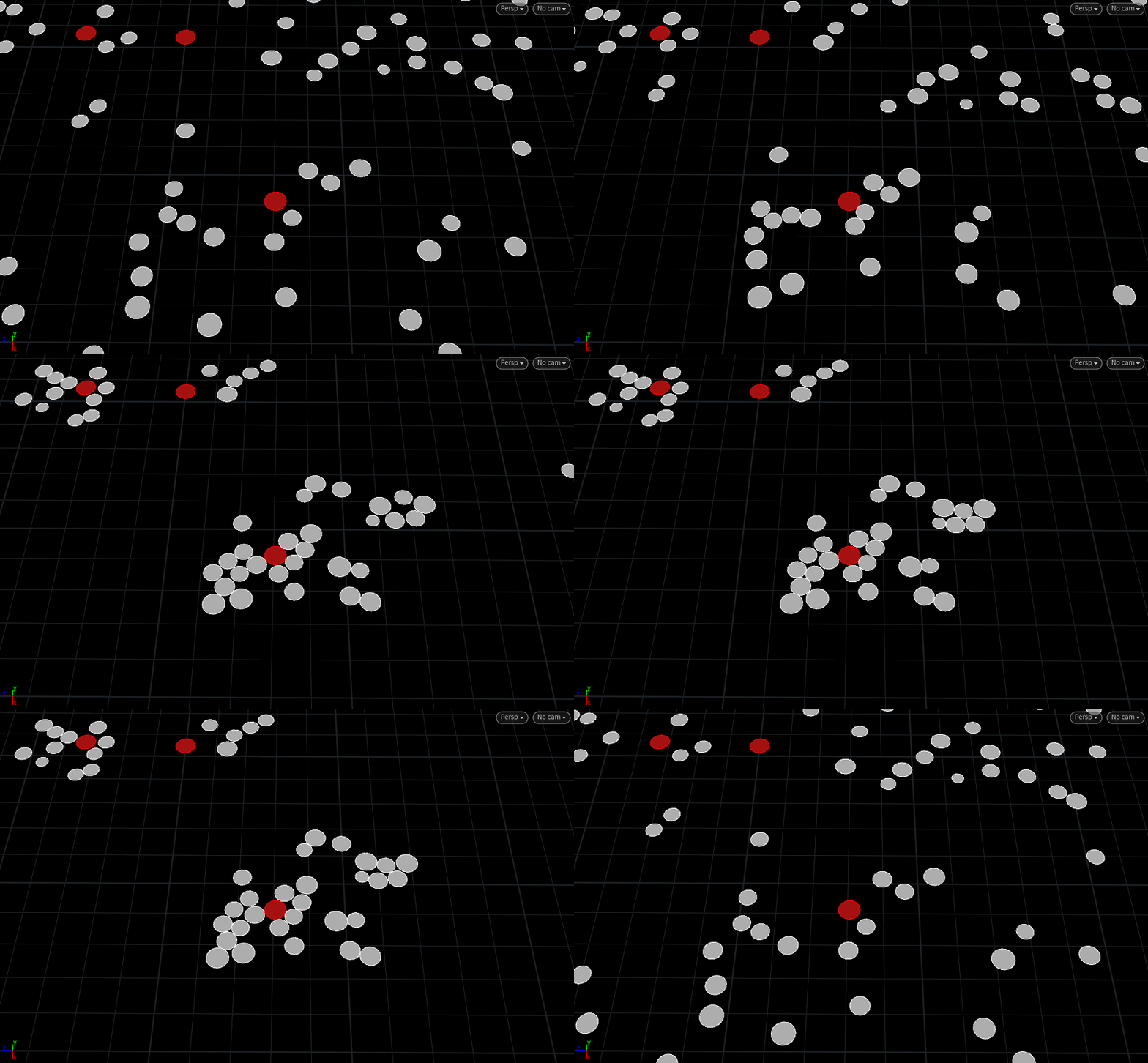
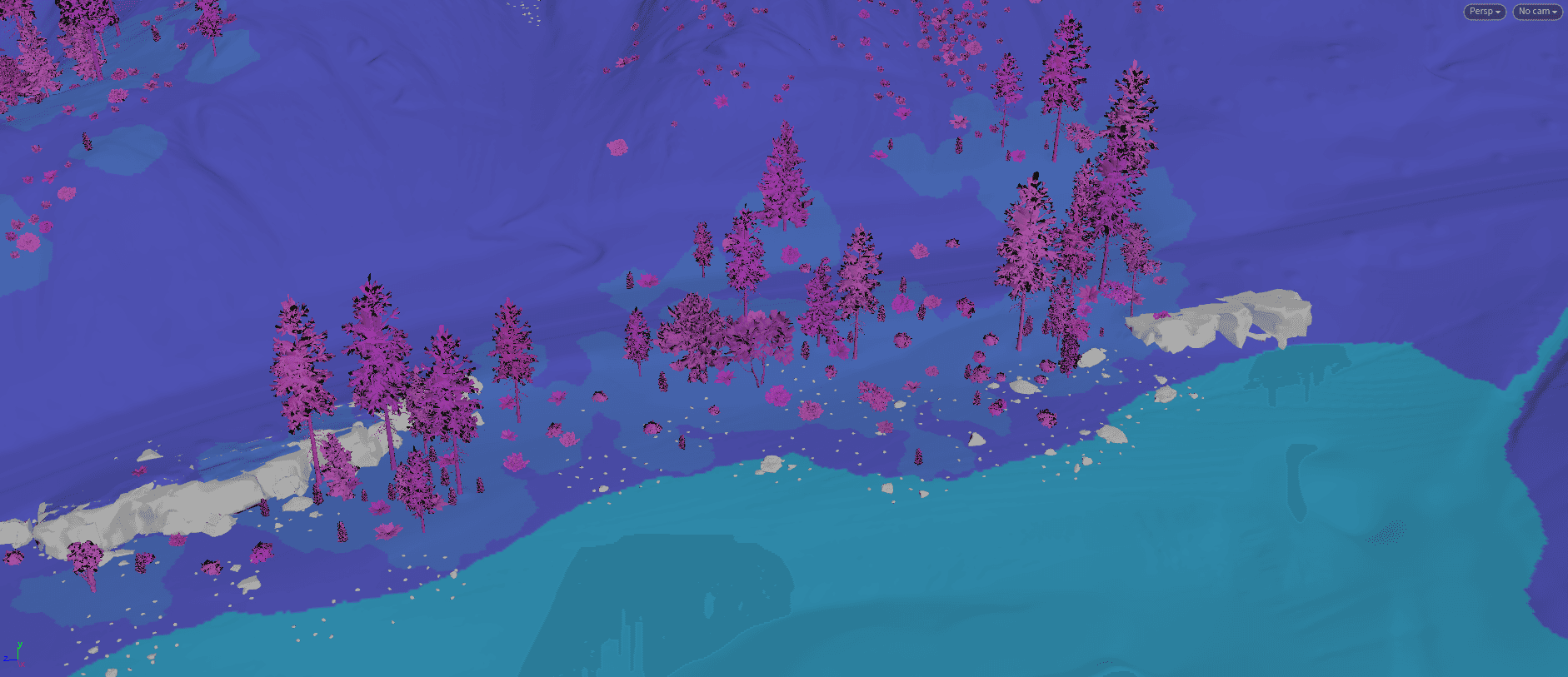
During my contract, the main task I was responsible for was making algorithms to automatically populate vast open worlds with vegetation. The algorithm used terrain data as inputs: elevation, slope, curvature, sun exposure, and water distribution, and simulated how forests react and adapt to these conditions. The final product was a Houdini tool with a large set of parameters, making it possible to configure different biomes, each with their own particularities and species. This tool was then run on a large 32x32 km map, automatically covering the world with realistic vegetation.
What I've Learned
Developing this pipeline pushed me into extensive research on how forests function as systems. A forest is not a collection of individual trees; it is a single organism, a distributed entity whose parts communicate, compete, and cooperate.
The forest is as much a living being as the individual trees that compose it, and emergence is not an abstraction but a fundamental principle of living systems.
And this is ultimately what I ended up simulating: not individual trees, but forests as a whole. This work made me think more carefully about life itself, about how complexity arises from simple rules, and how the boundaries we draw around individual beings are, in many ways, arbitrary.